
 Start the Nexus
Joypath™ Grip Strength. A Two Articles Series (2)
Article 2: How to Improve Grip Strength: Gentle, Joyful Ways to Build Stronger Hands
Small habits, a few minutes at a time, may help support the everyday tasks you love.
Imagine opening a jar on the first try, carrying all the groceries in one trip, or holding a garden tool for an extra few minutes without your hands tiring. Moments like these are easy to take for granted, and they are well worth supporting.
The good news is that you can improve grip strength with small, enjoyable habits. You do not need a gym, special equipment or long sessions. A few minutes, a few times a week, is a perfectly good place to begin.
This is Part 2 of our series. In Part 1, we explored grip strength as a fitness marker linked to living longer. Here we focus on building it, at your own pace.
Why Build Grip Strength After 50, and What May You Gain?
Muscles generally respond to regular use at any age, and the muscles that power your grip are no exception. Gentle, consistent practice may help you build forearm and hand strength gradually. As Part 1 noted, meta-analyses such as García-Hermoso and colleagues (2018) link higher grip strength with lower mortality risk, but association is not cause.
Several Joypath™ Pillars are at work. Body, because grip is part of overall strength. Fuel, because recovery and energy support any new habit. Life Design, because the things you enjoy, from cooking to travel to time with family, depend on your hands.
What you may gain:
- More ease with carrying, opening and holding
- Greater confidence in the kitchen, garden and while traveling
- A small, achievable habit that builds momentum
- A sense of capability that can spill into other areas of life
Joypath Practice: How Can You Improve Grip Strength Safely at Home?
Starting small is enough. Some people find it helpful to choose one or two of these and keep them going for a few weeks before adding more.
Soft Squeezes. Squeezing a soft ball or therapy putty may help build hand and forearm strength gradually, and it is a gentle choice on lower-energy days. For example, you could squeeze for a few seconds, release, and repeat ten times while the kettle boils or a podcast plays.
Farmer’s Carries. A farmer’s carry means walking while holding a weight in each hand, which may support grip, shoulders and posture together. For example, you might carry two lightly filled grocery bags or small dumbbells down the hallway for 20 to 30 seconds, rest, and repeat a few times.
Dead Hangs. A dead hang means holding a sturdy bar with relaxed arms. You may prefer to keep your feet on the floor or a low step for support. For example, you could begin with 5 to 10 seconds and add a few seconds over several weeks.
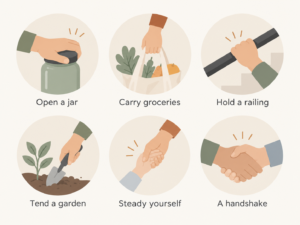
Everyday Grip Moments. Daily life already offers opportunities. Kneading dough, wringing out a cloth, gardening or carrying a watering can all engage your hands. For example, you might choose one task each day and enjoy it a little more slowly.
A note on comfort and safety. Mild muscle tiredness is common when you begin. A sharp or lasting pain may be a sign to pause and check in with a professional. If you have arthritis, hand, wrist or shoulder discomfort, or a heart or blood pressure condition, a physical therapist or doctor can help you choose what suits you. Breathing steadily, rather than holding your breath, is a common suggestion during any gripping effort.
What Might a Gentle Week Look Like?
Everyone’s rhythm is different. One option is a light schedule like this:
- Monday: Farmer’s carries, 3 short rounds
- Wednesday: Soft squeezes, 10 repetitions each hand, plus a short dead hang if comfortable
- Friday: Farmer’s carries again, perhaps with a little more weight or a few more seconds
- Daily: One everyday grip moment, such as kneading, gardening or carrying
Consistency matters more than intensity. Two or three short sessions a week, kept comfortable, may do more for you than one demanding effort. You may also want to recheck your grip once a month, as described in Part 1, simply to notice your own trend.
NexusEffect™ + Joypath Moment
NexusEffect: A small Body habit can ripple outward. Building grip may increase strength (Body), build confidence as you notice progress (Mind), encourage you to eat enough protein and drink water for recovery (Fuel), and make hobbies like baking or gardening feel easier (Life Design).
Joypath Moment (illustrative only; Carol is a fictional character): Carol, 71, loves baking and knitting but found jar lids increasingly frustrating. She chose two small habits: soft squeezes while the kettle boiled, and carrying two grocery bags the length of her driveway twice a week. After about eight weeks, lids felt easier, and her monthly reading with her physical therapist had edged up a little. Her biggest surprise was how much she looked forward to the routine. She did not set records. She simply enjoyed her kitchen with a little more ease.
Joypath Essence™
Stronger hands are not about records or comparison. They are about the small, joyful moments your hands make possible every day. A few gentle minutes, repeated over time, can be enough to notice a difference. You may want to choose one practice this week and see how it feels
Sources
- García-Hermoso et al. 2018, muscular strength and all-cause mortality meta-analysis (Archives of Physical Medicine and Rehabilitation)
- Cooper, Kuh and Hardy 2010, objectively measured physical capability levels and mortality (BMJ 341:c4467)
- Cooper, Kuh and Hardy 2009, physical capability and subsequent mortality (J Epidemiol Community Health, 63 Suppl 2; source of the 5 kg figure)
- López-Bueno et al. 2022, thresholds of handgrip strength for all-cause, cancer and cardiovascular mortality (Ageing Research Reviews)