
 Start the Nexus
Balance After 50. Steadier on Your Feet
Small, low-effort practices that may help you move with confidence for years to come.
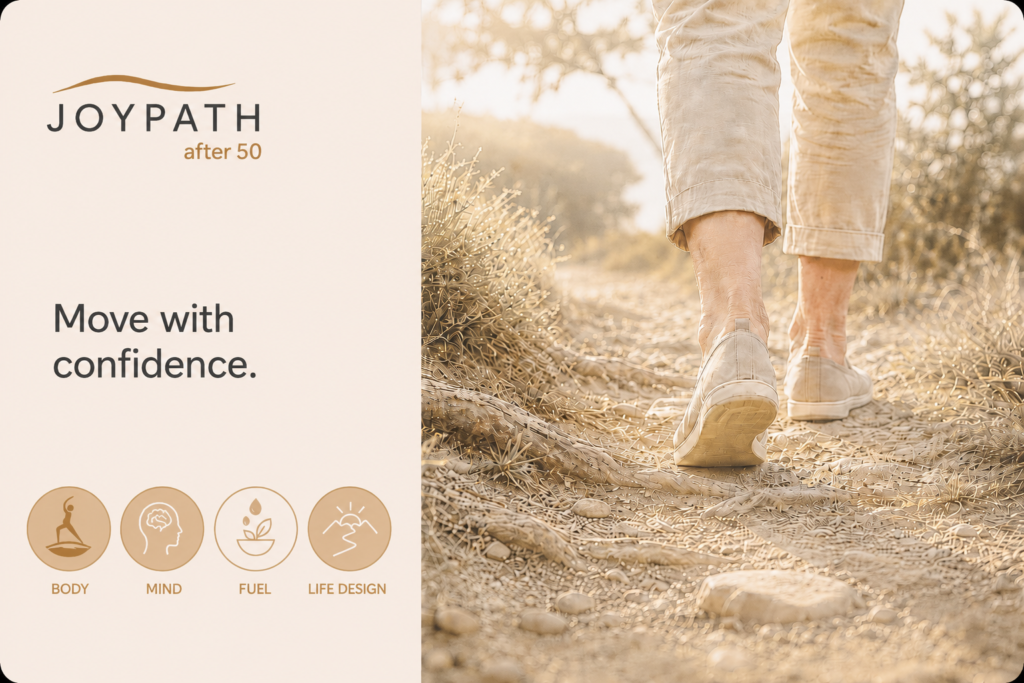
You Notice It Before You Talk About It
You step off a curb and catch yourself a little quicker than you used to. You reach for the railing on stairs you’ve climbed a thousand times without thinking. Nothing dramatic happened — you just noticed.
That small catch isn’t in your imagination, and it isn’t something you did wrong. It’s simply a sign that balance, like strength or energy, benefits from a little attention as we move through our 50s and beyond.
Here’s the encouraging part: balance after 50 responds well to small, consistent practice. This isn’t about becoming an acrobat. It’s about protecting the steady, confident movement that lets you live life on your terms.
Key Takeaways
- Balance naturally shifts after 50 — it’s normal. It’s biology
- Left unattended, you might quietly narrow your world
- Balance can be trained at any age, in small, low-effort ways
- A few minutes of daily practice may meaningfully support stability over time.
- Steadier balance often lifts confidence, activity, and independence together — the NexusEffect™ in action.
Why Balance After 50 Matters
Balance isn’t one thing. It’s a coordination act between your inner ear, your eyes, the sensors in your feet and joints, and your muscles — all reporting to your brain in real time, many times per second.
After 50, each part of that system can quietly lose a step. Muscle and reaction speed may fade gradually if unused, joint sensors can become less precise, and vision changes can subtly affect depth perception. None of this happens overnight, and none of it is a verdict — it’s simply a system that, like any other, tends to perform better when it’s used.
Balance isn’t only about avoiding a fall, though that matters too. It’s about what balance quietly protects: your willingness to take the uneven trail, to carry the groceries in one trip, to get down on the floor with a grandchild and rise again without a second thought.
When balance feels uncertain, it’s understandable to start avoiding situations rather than training for them. Over time, that avoidance can gently shrink a very full life into a smaller, more cautious one — which is exactly why a little attention now can matter so much.
The NexusEffect on Balance
Balance is a Body capacity, but it rarely stays contained to the Body. Uncertain footing can quietly affect confidence (Mind) and how freely you move through the world (Life Design). That’s the NexusEffect: train one capacity, and the benefits tend to ripple outward — steadier footing today, more confidence and freedom tomorrow.
Joypath™ Practices: Small Steps for Steadier Days
Balance practice doesn’t require special equipment, a class, or an hour you don’t have. It asks for consistency, not intensity — and a wobble along the way is simply part of the training.
- Single-leg stands. You might hold onto a counter and lift one foot for 10–15 seconds, then switch sides. It slips easily into brushing your teeth.
- Heel-to-toe walking. Walking a straight line, placing one foot directly in front of the other like a tightrope, for 10–15 steps.
- Stand-to-sit without hands. Rising from a chair without pushing off with your hands, which builds the leg strength balance depends on.
- Joyful motion on varied ground. A short stretch of grass, sand, or gravel (with care) challenges your balance system in useful ways pavement never does.
- Slow, mindful transitions. Simply pausing for a beat before standing up or turning around gives your balance system time to catch up — a small habit with an outsized payoff.
None of these need to be perfect. A wobble isn’t a failure — it’s the training itself. Progress, not perfection, is the point.
Disclaimer: Joypath is for educational purpose only. Talk to your doctor which Practices are safe for you.
A Real-Life Example
Carol, 63, noticed she’d started avoiding her favorite hiking trail because of a rocky section near the start. Rather than give up the trail, she added two minutes of single-leg stands each morning while her coffee brewed, and took a few heel-to-toe steps down her hallway most evenings.
Within a few weeks, she felt noticeably steadier — not just on the trail, but everywhere. She also found herself standing a little taller and moving with more ease in general, and she felt more confident about an upcoming trip involving cobblestone streets. One small Body practice, and a ripple of confidence across her whole week.
Frequently Asked Questions
Does balance really decline as part of normal aging, or only if something’s wrong?
Some gradual change in balance is a typical part of aging and may occur even without an underlying condition. That said, sudden or significant changes in balance are worth discussing with a healthcare professional, since they can have a range of causes.
How often should I practice balance exercises to notice a difference?
Consistency tends to matter more than duration. A few minutes most days may support steadiness more than one long session per week, though individual results vary.
Is it safe to do balance exercises alone at home?
For most healthy adults, simple movements like single-leg stands near a stable countertop are considered low-risk. If you have a history of falls or a health condition affecting balance, you may want to consult a professional before starting a new routine.
The Joypath Essence™
Balance after 50 doesn’t stay the same on its own — and that’s not bad news, it’s useful information. It means the trajectory is still yours to shape.
You don’t need a dramatic overhaul. You need a countertop, a few spare minutes, and a willingness to wobble a little on purpose.
That’s how you keep saying yes to the curb, the trail, and the floor with the grandkids — for the next 20 years and beyond.
Disclaimer: Joypath After 50™ is for educational purposes only and is not a substitute for professional medical advice. Please consult your doctor before making health-related decisions.