
 Start the Nexus
Joypath™ Grip Strength – A Two Articles Series (1)
Article 1: Grip Strength: A Fitness Marker Linked to Living Longer
A few seconds with a hand squeeze may offer a useful clue about whole-body fitness.
You may already keep an eye on your steps, your sleep or your resting heart rate. There is another number that takes only seconds to check, and it is easy to overlook: how firmly you can squeeze.
Grip strength is a simple fitness marker, and researchers have linked it to living longer. That does not mean a strong hand guarantees a long life. It does mean your grip may offer a helpful clue about how well your body is working as a whole.
This is the first article in a two-part series. Here we look at what grip strength is, what the research says, and how you may want to measure it. Part 2 turns to building it.
What Is Grip Strength, and Why Is It Called a Fitness Marker?
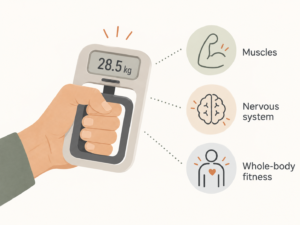
Grip strength is the force your hand can produce when you squeeze. It is usually measured with a handheld device called a dynamometer. The test takes seconds, needs no laboratory and is easy to repeat, which is why clinicians and researchers use it widely.
A fitness marker is a simple measure that reflects something bigger. Your grip draws on muscles in the forearm, hand and shoulder, along with the nerves that coordinate them. When these systems work well together, grip often mirrors overall muscular fitness and nervous system health.
Think of it as a dashboard light. It does not diagnose anything and it does not tell the whole story, but it can prompt useful questions.
Grip also shows up in daily life. Opening a jar, carrying groceries, holding a railing, tending a garden and steadying yourself after a stumble all rely on your hands. These are the moments that connect to independence, which is why the Body Pillar is most at work here.
What you may gain from knowing your number:
- A simple baseline you can return to over time
- A way to notice trends rather than guess
- A useful starting point for a conversation with a clinician
- A little extra motivation, which supports the Mind Pillar
Is Grip Strength Really Linked to Living Longer?
Research says yes, as an association. A 2018 meta-analysis by García-Hermoso and colleagues pooled 38 studies and about 1.9 million adults. It found that higher handgrip strength was associated with a lower risk of death from any cause. A 2010 BMJ systematic review by Cooper and colleagues reported that people in the weakest quarter of grip strength had about 67% higher mortality risk than those in the strongest quarter, after adjusting for age, sex and body size. An earlier analysis by the same group (2009) linked each 5 kg higher grip strength to roughly a 10% lower mortality risk.
A 2022 review by López-Bueno and colleagues, covering 48 studies and more than 3 million participants, went further. It concluded there is strong evidence linking lower handgrip strength to higher all-cause, cancer and cardiovascular mortality risk. The same review noted that the pattern varies depending on the cause of death.
It helps to be clear about what this does and does not mean. These are observational studies. People with a stronger grip often have other healthy habits too, so grip is best seen as a marker, not a switch. Whether training grip itself adds years to life has not been established, and a stronger grip cannot guarantee longevity.
What is encouraging is that grip is measurable, it responds to practice, and it supports the daily tasks that keep life independent and enjoyable. That makes it a helpful number to know, whatever its limits.
How Can You Measure and Track Your Grip Strength?
Starting small is enough. One reading, once a month, is a perfectly good beginning. Here are a few options.
Get a Baseline Reading. You may want to ask a clinician, physical therapist or fitness professional about a hand dynamometer test. For example, you could request one at a routine visit, since it takes only seconds.
Keep a Simple Log. Some people find a notebook or phone note works well. One option is to record both hands once a month, at a similar time of day and with the same device, because different devices can give different readings. The aim is to notice your own trend, not to compare yourself with anyone.
Notice Everyday Signals. Informal clues can add context, though they do not replace a measured test. For example, you might notice whether carrying two grocery bags feels easier or whether a stubborn jar lid opens more smoothly.
Look at the Bigger Picture. Grip is one signal among several. You may want to consider it alongside your walking pace, balance, energy and sleep. A sudden or unexplained change in strength is worth mentioning to a clinician.
NexusEffect™ + Joypath™ Moment
NexusEffect: A simple Body measure can ripple outward. A number to track may build motivation and curiosity (Mind), and support the confidence to keep doing the activities you love (Life Design).
Joypath Moment (illustrative only; Robert is a fictional character): Robert, 67, a retired teacher, asked his physical therapist for a grip reading at a routine visit. He began logging it monthly in a small notebook. After three months, his numbers stayed about the same, which he found reassuring. The monthly check-in also nudged him to start walking twice a week with a neighbor. He did not chase records. He simply enjoyed having a clear, friendly picture of how he was doing.
Joypath Best Practice: How Can You Measure and Track Your Grip Strength?
The Nexus Effect — Cross ripple benefits between Joypath Pillars
Body: Increased grip Strength will develop your Body Pillar.
Life Design: A stronger Body Pillar will support the confidence to keep doing the activities you love.